

When I first started shooting, the most popular targets we would take to the range were paper plates and water bottles. The makeshift targets did the trick. I never really had an issue with them until I discovered steel targets. I still enjoy shooting my recycled makeshift targets, but also mix in some steel whenever possible.
I discovered the true benefits of steel targets when I took a tactical shooting class where the main targets were AR500 steel targets. After the class was over and I returned home, I immediately ordered a couple smaller gongs. Since then, I’ve come to acquire a dozen or so steel targets in various shapes, sizes, and thicknesses.

Why I Love Shooting Steel
You won’t find many better sounds than the ping! that is heard after hitting a steel target downrange. It provides an instant hit confirmation at most any distance. The audible confirmation is especially helpful when looking for confirmation on long-distance shots where it may be difficult to see the target.
As long as you purchase quality targets, made from a harder steel such as AR500 and follow the recommended distances and calibers, the targets should last you a lifetime. Even after the effects from the elements such as rain and snow, multiple layers of spray paint, and taking thousands of hits, they continue to ping! with each successful shot. The lazy part of me also appreciates not having to constantly run downrange to replace targets.
General Guidelines
Aside from the standard shooting precautions such as eye and ear protection, there are a few additional safety measures to take when shooting steel. First, you want to ensure you are using the appropriate calibers at the appropriate distances. I won’t bore you with listing every single caliber that each type of steel is rated to withstand. Instead, I’ll use AR500, as it’s the most popular steel used for targets, and provide what I have found is a good rule of thumb.
Place your targets no closer than 10 yards for pistol calibers or 100 yards for rifle calibers and keep the bullet velocity under 3,000 fps. A target crafted with 3/8-inch-thick steel is typically a good middle ground, where you’ll be able to shoot essentially all pistol calibers and up to a .308 rifle round.
I’d like to add, it’s the thinnest steel that I shoot or would recommend. If you step up to 1/2-inch steel, it expands the caliber possibilities to include rifle rounds up to .338 Lapua. At distances over 400 yards, AR500 steel will beatings from the insanely powerful .50 BMG.

Negatives of Steel Targets (Sort of)
While there are many advantages, no target can be considered perfect. Steel targets can be an expensive upfront investment, even though they can last a lifetime. They are also heavy… Duh! We are talking about steel.
Technically, you don’t have to bring something to hold the targets. You could simply prop them up against various items, However, that is a recipe for disaster. There have been plenty of cases of ricochets causing injuries.
You should already be practicing proper gun safety. Part of that is being responsible for the bullet from the moment it leaves the barrel. Follow the suggested distances and ensure the target is angled downward slightly. That way, you have the best chances of avoiding dangerous ricochets.
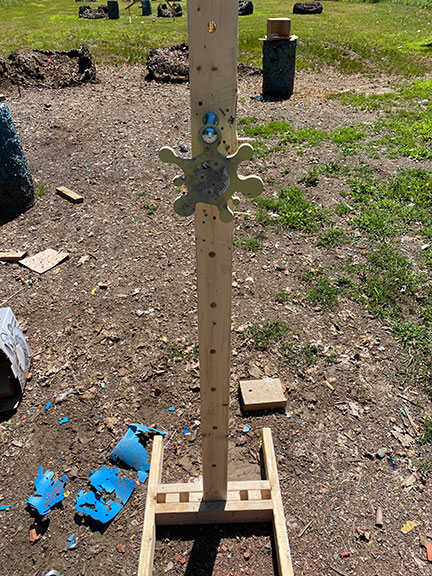
Several companies make economic target holders. For those who are handy, it is not hard to build your own target holders. I use a simple DIY design built with 2x4s or something comparable, and replace the wood once it’s taken too many shots.
Complete Your Setup
Once you’ve ordered your targets, don’t forget you’ll need a way to hang or mount them. The easiest way is to buy a pre-built stand that comes with all the necessary hardware, but those can be pricey. Alternatively, you can build your own stands out of common building materials such as 2x4s, metal pipes, PVC, or similar. Then, simply grab a few carriage bolts, nuts, springs, washers, and you’re set.

I mentioned spray paint earlier, because it’s also good to have some on hand at the range. Spray paint will easily mask your previous target hits. Bright colors such as white make the targets easier to spot. I usually bring a can of white and then one that really stands out, such as an orange or yellow.
With the variety of steel targets available today, you’d be hard-pressed to not find some that suit your needs and objectives. Whether you’re training for speed, distance, or just enjoying a range day with friends, steel targets are a great option.
Do you prefer to shoot steel or paper targets? Let us know in the comment section which is your favorite, how you train with each target, and why.
Ryan is a firearms and tactical gear enthusiast that has maneuvered himself into the firearms industry over the past decade. While his full-time career is outside of the industry, he has consulted for dozens of firearms and tactical gear related companies. He enjoys conducting tests and evaluations, shooting product photography and developing marketing strategies for them.
If he’s not spending time with his family, you’ll likely find him at the range or driving around looking for photo shoot locations. You can check out some of his photos and other content on Instagram (@theguygearreview).
Steel targets reduce walking, and are a fun, practical way to score a contest.
Working with a handgun, I think paper is generally better for training and practice, because a miss on steel teaches nothing useful. Did I miss by a gnat’s hair, or a foot? High, low, left, or right? Wild spray or a consistent group not on point of aim? Paper can tell me all those things, give me a bit of exercise, and generally get more tangible and intangible value from a box of ammo.
@ ROCK IT.
Even “Serpentine Chain” will break upon impact with a bullet! And unlike common chain serpentine chain isn’t flexible in all directions of swaying motion as common chain is. If you want your target to swing side by side or back and forth serpentine chain will do that, but it won’t do both side by side and back and forth motion at the same time. And unlike common chain, serpentine chain require lubrication to stay flexible. So the real question is how much are you willing to spend on a flexible suspension line. You also might want to consider Military Grade Kevlar Threading of 30/3 cordage which will support up to ~85-pounds of weight and is virtually invisible to the naked eye beyond 20-meters distance…
I usually do both paper and metal targets. I start with paper targets and do my “precision” shooting (match grade ammo with good glass scope) and then transition to metal (red dot and iron sights) and just ping, ping, ping. Of course, with today’s cost of ammo, less ping, ping, ping than I used to.
There is not a better way to start the day. Well, except, you know, I am a “morning guy.” 🙂
Seems every time I used chain to hang steel, the chain ended up being the first casualty, and having to repair/replace it. So in the interest of ingenuity, changing the serpentine belt on my car one day, I thought how much better this would be than chain? Well, it turns out it is much better, and last considerably longer than chain. Yes, it gets holes in it, but so far it has not become a casualty to the point of not doing its job, before the paint is all gone. So have your friends save their serpentine belts, or pay a visit to you auto repair shop, to get the treasure from their trash.