
Let’s make a statement right off the bat that doesn’t have any room for argument. Without the National Rifle Association, there would be no police training.
The NRA began offering police training more than one hundred years ago, and everything we do sprang from these early attempts and followed to the modern, well-organized matches fired today.
In Practical Police Course shooting, the course of fire was set at different distances and for different strings of fire, with the revolver fired and reloaded.
This promoted marksmanship among peace officers and some became very good shots. It is true that match guns came to rule the match.
These expensive handguns with heavy barrels and jewel-like actions were not practical for duty use, but quite a few matches were fired with the .38 Special and .357 Magnum revolvers that officers carried.
These included the Smith and Wesson Military and Police, K-38 and Combat Magnum. Colt’s Python, Official Police and Officers Match, as well as the Shooting Master, were also used.
As far as I know, the first official training took place under Teddy Roosevelt in the NYPD just before the turn of the previous century.
Many recruits were taught target marksmanship, which was meaningless for combat shooting but a good start.
Ed McGivern, the famous exhibition shooter, taught police officers to shoot well and incorporated shooting on the move and used double-action fire exclusively.
Practical Police Course stressed firing at different distances and firing under stress. It should be noted that there have been several unfortunate incidents in which officers were confronted with rifles at longer distances.
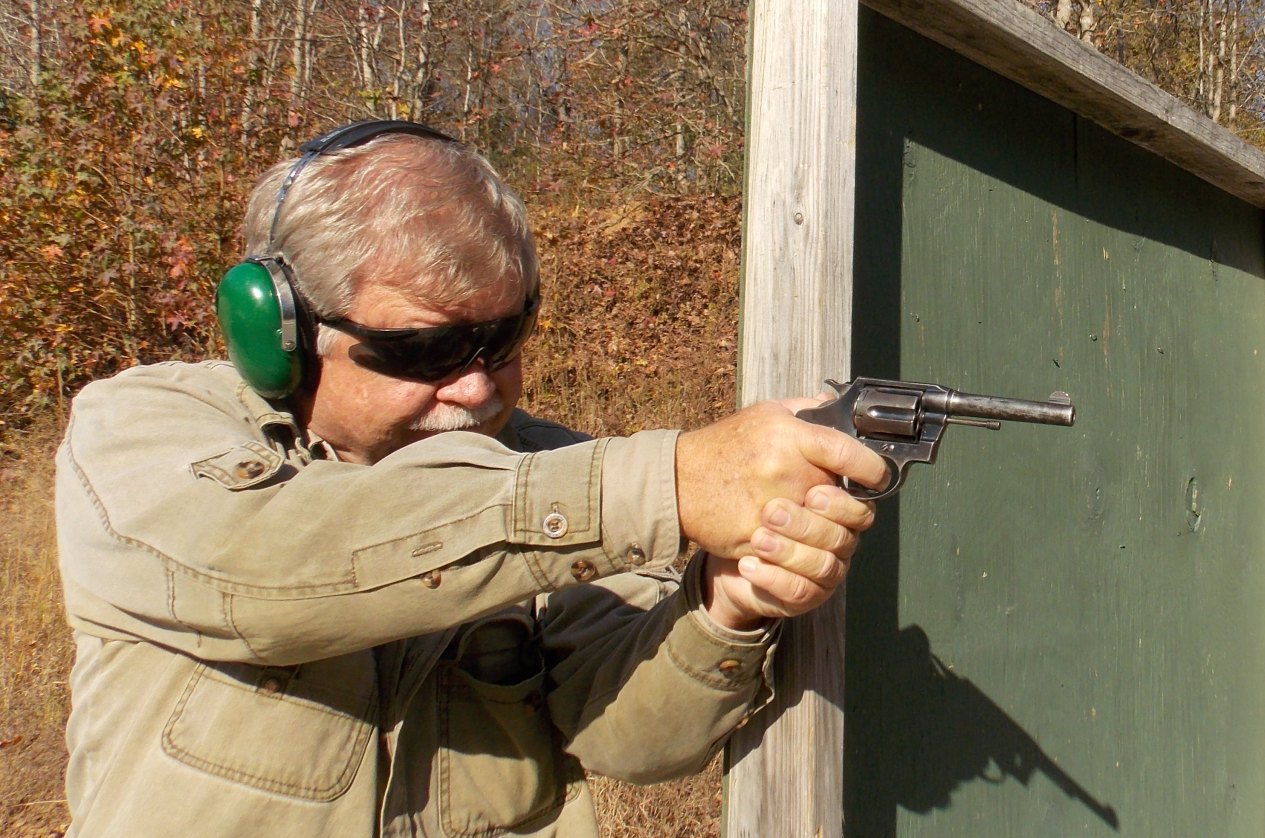
An officer that fired Practical Police Course with this revolver at 50 yards would be far from helpless at this range.
A course of fire that stresses shot placement, center of mass shooting and accuracy with a strong component of speed thrown in, is a good thing.
What is Practical Police Course Shooting?
PPC incorporates several elements of fire. This includes firing two, twelve-shot strings at 15 yards, with reloads, for a total of twenty-four shots.
The match also includes one-handed barricade, kneeling and right-hand barricade. Six shots in 90 seconds might be called on for the longer distances. Sitting and firing is also included in some of the matches.
You will have to get good at shooting in different stances to be competitive in all aspects of the course.
Here is the PPC course of fire, per the NRA:
Practical Police Course Open Class Firearms Matches (revolver and semi-automatic, the course of fire is the same for both types of guns. All matches are based on strings of 6 shots).
- Match 1 – 12 rounds fired in 20 seconds with a reload from 7 and 15 yards (24 shots total).
- Match 2 – 18 rounds total, fired from the 25-yard line in 90 seconds with 2 reloads. Six rounds from each of three positions: kneeling unsupported, weak hand with barricade and strong hand with barricade.
- Match 3 – 24 rounds fired in two minutes, 45 seconds with four reloads. Six rounds are fired from each of four positions: sitting, prone, weak hand with barricade and strong hand with barricade.
- Match 4 – 24 rounds total, fired from the 25-yard line in two strings of 12 shots each, time limit is 35 seconds per string.
- Match 5 – 60 rounds total, seven-yard line 12 shots in 20 seconds (half of Match 1), 25-yard line repeat of Match 2, 50-yard line repeat of Match 3, and then a final six shots from the 25-yard line in 12 seconds without support.

At an agency I trained with in the late 1970s, the range master, a tough old bird with great experience, devised his own version of the state course. We fired sixty rounds.
We began at 50 yards and eventually walked down to the seven-yard line, firing the tougher long-range shots first. The final six rounds were fired with one hand.
It wasn’t rare for the faster shooters to fire at 50 yards, advance to 25, and then walk to 15 yards as the man to the left or right was firing at the 25 or 50-yard target — you were on an individual pace.
While this isn’t quite the machine gun over the head of SEAL teams, you had to keep your head straight and fire straight. I don’t think anyone does this type of course today.

Even forty years ago, there was something of an equipment race. A good shot concerned with combat ability might carry a six-inch barrel Smith and Wesson known as the K-38.
The four-inch barrel Combat Masterpiece was issued to many agencies. This was a favorite of range officers. The standard Military and Police revolver and Colt’s Official Police were fixed-sight, issue revolvers.
These handguns were surprisingly accurate. It wasn’t unusual for a good shot using a target-grade revolver to put six shots into three to five inches at 50 yards, firing from a barricade.
The K-38 and the larger Model 27 .357 Magnum were very accurate handguns. Firing from a solid barricade firing position in double-action, these revolvers turned in excellent results in skilled hands.

Ammunition for PPC Shooting
The primary load used was a .38 Special 148-grain wadcutter. This is a cookie-cutter shaped bullet seated flush in the cartridge case.
The goal of the design is to offer plenty of bearing surface to achieve good accuracy. The deep seating produces 700 to 750 fps with minimal powder. The loading is often very accurate.
Some agencies used factory ammunition or bulk reloaded ammunition. Sometimes the ammunition was excellent quality, as in the case of the old 3-D ammunition company.
Some local companies used lead bullets as soft as they could get away with. Accuracy suffered and plating buildup was difficult to clean. Some of us used the wonderfully well-made Star reloading machine.
This load eliminated any problems with recoil. At fifty yards, you held on the neck to plunge bullets into the X ring.

PPC is still an interesting and challenging pursuit. If you own a classic revolver, I suggest you get it out of the safe and go to the range with a good supply of ammunition.
Run the Practical Police Course a few times with the revolver and, as skill builds, you will have greater respect for the revolver and the great shots of old.
How do you feel about training courses? What type of training drills do you perform at the range? Let us know in the comment section below!
Well i9 shoot the NRA Ppc course every Sunday, it is the best and toughest course ive ever shot. but i average a 91.5 score
In the 1960s we fired from the 50, 25 and 7 yd lines. A perfect score was 300, all shots in the bottle. I used a S&W .357 Magnum 4” bbl. Your article sure brings back memories. The weapon served me well on the job and on the Pistol Team. My Magnum still looks pristine with thousands of rounds of wadcutters through it. It is 63 years old and I am 85.